
Wednesday, May 27, 2015
Addendum: Notes on Wildlife
The Galapagos is a unique and fascinating place, although there is not the diversity of wildlife that one might expect, partly because of the long distance from the mainland. The islands were originally formed from volcanoes, rather than having broken off from a larger continent, in contrast to many other islands around the world.There are few mammals endemic to the islands (2 bats and rice rats, none of which we saw) other than marine mammals, while reptiles can travel long distances without food and water, which is why they dominate today. Much of the islands are National Park lands, and inaccessible to visitors, except for researchers (which is as it should be!). Thus we were privileged to visit only limited areas. Nevertheless, we enjoyed the opportunity to see what we could. There were Galapagos sea lions everywhere, sunning on the black rocks, lounging on piers and abandoned (and unabandoned) boats moored in the water, frolicking in the water, and, most delightful, we observed a mother teaching her pups to swim, by pushing them off the rocks into shallow water, which they resist, and herding them out through the water until they must swim their way back to the rocks, where she starts again. She keeps a close eye on them to keep them from drowning, we’re told. We also saw marine iguanas everywhere, in many sizes.
There are two major groups of giant tortoises, defined by their shell shape, dome or saddleback, based on whether they eat from the ground (the former) or have to reach up for vegetation (the latter). We saw 3 or 4 of the 16 varieties of finches, which of course, along with the tortoises, served as Darwin’s inspiration for the theory of evolution, as they started from a common ancestor but adapted to the islands’ varying environments. We also saw brown pelicans, petrels, royal terns, black-winged stilts, American oystercatchers, Galapagos mockingbirds, familiar herons and egrets, and smooth-billed anis. We saw flamingos, which have a breeding population on the islands. Sadly, on our bike trip we passed a frigate bird with a broken wing, struggling on the side of the path, probably eventually to become food for fish, raptors, reptiles, and/or insects. We saw a variety of cacti, which again vary not only from island to island but also in different zones on the same island. One interesting feature of island flora is that most endemic flowering plants have yellow flowers – this is thought to be connected to pollinators who are attracted to yellow.


Darwin Station - May 15
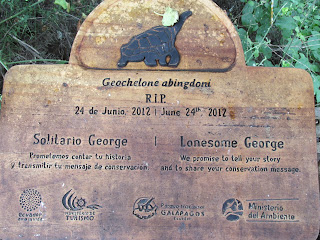
Almost time to fly back to the mainland. However, we are chagrined to find that first we are scheduled to visit the Charles Darwin Research Station at 6am, before breakfast. Grumbling ensues. However, our intrepid guide arranges for coffee in the hotel bar, and one of our new friends generously shares his stash of protein bars, as he has throughout the trip. Fortunately it is a short walk to the Station, which is in reality a breeding center for tortoises and land iguanas, which are much scarcer than the marine iguanas we have seen everywhere. It is already extremely humid, but an otherwise pleasant outdoor park. We see several types and sizes/ages of tortoises, including Super Diego, who has replaced Lonesome George as the star of the park, because he is the father of many other tortoises. We start nudging Luis (Lucho), our gentle and laconic National Park naturalist, back toward the hotel and finally get some breakfast, soon followed by the same transportation sequence from yesterday in reverse. We are expertly herded by Tavo and Lucho into jockeying for position on the various buses and boats to make our flight to the mainland in time. We arrive back in Guayaquil, to stay at the same upscale Hotel Oro Verde (“Green Gold”) from the beginning of the trip, with A/C, bellpersons to bring up our bags, great wi-fi and comfortable chairs in the lobby, a fitness center and big swimming pool (which several of us enjoyed), to relax and enjoy our last afternoon in Equador.

Monday, May 25, 2015
Kayak Adventure - May 14 Part II
Next stop is a National Park beach for kayaking. Some of us have to scramble to drag out various kayaking accoutrements such as bathing suits, from our packed bags in the rear of the bus, and in the rush I forget my kayak booties. Then we line up for the single bathroom stall in the small Park building, for peeing and changing (the other one is being fixed). Finally we lay out towels under some trees and eat a picnic lunch of chicken/bacon sandwiches, swatting the occasional biting horsefly.
Then it is time to kayak. Ben and I look doubtfully at the breakers out past the calmer cove. Ben decides he prefers a siesta, but I don’t want to just sit around while everyone else paddles, so Tavo, our intrepid guide, agrees I can paddle with him. Neither of us has our glasses on (my contacts which I would have normally put in for this were back on the bus), but he seems unperturbed. I get some welcome vigorous exercise and things go well until we start in toward the far beach. We are heading perpendicular to the wave that catches us from behind, but the nose of the kayak goes down and then we are in the water. I blow water out my nose, pop to the surface, and actually remember to hang on to my paddle, although the badly fitting life-jacket pushes up against my neck. Tavo sees that I am OK and not panicking. He retrieves his paddle and turns over the boat, and hops on. With gentle coaching I am able to pull myself up, chest down across the back of the kayak, then twist my legs around so I am face down facing forward, then manage to get to my knees and finally sit back up in the seat. Yay! Instead of being bummed, I find myself elated that I was able to recover and I am glad we dumped (it was also nice to cool off!). But I decide that I had had enough for the day, so we turn around and paddle back to our launching point. It turns out one of the other couples also fell in before we did, although they were able to quickly recover, having had experience in surf (unlike me). Everyone else gets back in short order, and all are ready to head to the hotel. I feel quite elated the rest of the day, and Ben and I enjoy a complementary drink at the hotel bar before dinner, where we watch 2 waitresses folding napkins into penguins. I try too and succeed and we all laugh. Sadly, dinner out is the least interesting meal we have had, in a touristy restaurant and bar, with a really bad singer guitarist who unsuccessfully solicits tips from our table. We realize that we are gradually returning to civilization.


Planes, Buses, Boats, Oh, My! - May 14 Part 1
Because of the rough water, we are all thrilled when Tavo tells us that our travel company has organized an island hopper plane to take us from Isabela back to Santa Cruz Island, in place of another 2-3 hr boat ride, as we take the first step towards heading home. The small, empty concrete airport is surrounded by vegetation, which we all have to use to answer nature’s call since no one can find the key to the restroom. We crowd in close quarters into the tiny 9-person plane. After a smooth but loud 30 minutes or so, we arrive again on Baltra Island. We have the same sequence of deplane, get bags, get on public bus to cross island (including bags on board), get water shuttle to Santa Cruz Island, then finally get on our own small coach (with A/C!) to cross the island toward the tourist town of Puerto Ayora. Once again, I am dismayed that we will have multiple activities before even checking into the hotel later in the afternoon.
First we stop at a coffee farm that cooperates with the National Park to allow tortoises to roam freely back and forth between the Park land and the farm. Everyone changes into wellie-like rubber boots for a short tourist walk through the farm, where we see several free-range tortoises of varied ages and sizes. The highlands are very humid, although overcast, with occasional breezes. At one point, we come upon a tortoise that apparently poses for pictures with tourists. We are instructed that he will feel the vibrations of our feet, to stay some distance from his head, but to circle around behind (not too close) and crouch down for a picture. Ben and I are doubtful, but the tortoise doesn’t seem disturbed, so we agree, along with the others. The tour ends with a cup of delicious free organic coffee grown on the farm, then back to the lovely A/C on the bus, where our local guide Yogo, who also arranged the box lunches we'll eat later, passes around a basket of hard candies and mints as a nice treat. .
Biking, Hiking, and Tears – May 13
I slept long and hard, and actually felt ready for the next adventure (for a change). Today the water is too rough for our scheduled morning kayaking, so we go pick up rented mountain bikes, rusting and creaky, with intermittent gear slippages and iffy brakes, and bike along a path next to the rocky shore with crashing waves, into the National Park. It is a bit challenging biking through sand of varying firmness, and later black gravel, with some small hills toward the end. At one point the biggest guy on the trip crashes over when he is powering up a hill, up on his feet, and his bike couldn’t handle it, slipping a gear and throwing off the chain. I just walk my bike when needed, rather than trusting to its heavily-used mechanisms (or to my legs). Parking our bikes, we take a short hike up some steep steps, arriving at the Wall of Tears, built from lava rocks after WWII by prisoners from the island penal colony. The Wall had no purpose except to make them suffer, and many died during its construction, and the prison was later closed. On the bike ride back we splash through some patches of water across the path, as the tide has risen. After a late and delicious lunch, we have a rare afternoon off to once again enjoy the hotel, with actual time for an afternoon siesta, and then take advantage of the “drying” room (the open flat top of the hotel with several clothes lines strung across for our wet stuff) and also the free wi-fi available in the hotel lobby, with a wonderful view of the turbulent sky and pounding surf across the street on the beach.


Sunday, May 24, 2015
The Volcano - May 12
Today is the big 10 mile death march to see the active volcano, which we have been warned will be hot, long, and grueling. Although it turns out I could probably have gone the whole way after all, I decide in advance I will go part way, then return early for some long overdue downtime. Slathered with sunscreen, armored with sunhats, hiking boots, bandanas, and a liter of water each, we set off. We opt not to bring the camera or binocs, only essentials like water and sunscreen. Ben and I hold back a bit to form the slower group with our intrepid leader Tavo (we are now on nickname terms with him). It turns out to be overcast, cooler, and flatter than anticipated, and the mists come and go, sometimes obscuring the view, but on the way back lifting to show a spectacular panorama of the caldera. I still drip with sweat but hike steadily. Instead of going straight up, the trail circles quite pleasantly through vegetation around the huge caldera, 5x6 miles in size (and still increasing, as cracks in the solidified magma continue to appear, giving in to the pressure below). About 3 miles in, we rest and eat our box lunches on some benches under dense trees providing lovely shade. Tavo and I turn back, while the rest of the group, led by Luis (nicknamed Lucho), continues on a steep downhill to the solidified magma field, where it is black, rocky, and hot (from the lava as well as the weather) and there is a view of active magma. My hike back with Tavo gives me a chance to learn a lot more about Tavo and about Ecuador, which was quite interesting and inspires me to want to someday make a return trip to the mainland. I get back to the hotel after a solitary taxi ride with young taxi driver Steven, with whom I exchange some limited Spanish, then we listen to some traditional Equadorian music on the radio. Finally I get some downtime, first lolling in the lovely little atrium pool, cooling off, then shower, nap, writing, and relaxing in the lovely hotel. After everyone gets back later, we talk Tavo into an earlier dinner, traipsing in ponchos through the rain, for another wonderful dinner, spaghetti and risotto (for us veggies).


Saturday, May 23, 2015
Best Day So Far - May 11
Today we transferred to Puerto Villamil on Isabela Island, again via 2-hr water taxi but much smoother water, and arrived at the lovely Hotel Albemarle. A great breeze blew through the small open hotel lobby, which opened to an atrium inside. The sandy ocean beach just across the street was filled with palm trees waving fronds and framed with black rocks extending into the beautiful blue water, waves noisily crashing over them. A small cruise ship, a couple of large catamarans, and a cargo ship were anchored out in the bay. However, no time to enjoy it (yet).
After checking in, we walked through town to a forested outdoor tortoise breeding center, and saw tortoises of all shapes, ages, and sizes, where the National Park works to repopulate the islands to make up for the damage caused by humans bringing dogs, cats, goats, donkeys, and pigs to the islands, some of which have become feral, and are periodically subject to humane eradication programs, to save the endemic species of birds and reptiles. After another delicious lunch (most meals included an interesting soup, fresh fruit and vegetables, rice, beans, and seafood), we joined a National Park tour of Tintorella (named after the Reef Shark). The tight camaraderie we had developed within our small group was somewhat disrupted by having to share the tour with others (a combination of English and Spanish speaking tourists). We first enjoyed a “power” snorkel through big swells of ocean water out to several islets, where we each had to struggle to see and follow the person in front of us, especially difficult toward the end with the sun in our eyes. At one point, I was lucky enough to pop up just as the our young female Park Guide pointed out a sea turtle underneath the water, which swam to the surface, breathed, and then dove again. Ben saw a big starfish. Next we walked along the black lava shoreline and took a boat ride around the islets, where, for all the photo takers, we stalked the small Galapagos penguins, sea lions, blue-footed boobies, marine iguanas, frigate birds, and more.
Finally back at the hotel, our room was heavenly, on the second floor, with large stone tile floors, open stairways of bricks and wood, high ceilings, 2 modern sinks made of large bowls sitting on top, walk-in shower with glass door, firm comfortable beds with sheets (vs. useless duvets), many good pillows, and very welcome A/C, quiet, over the door, operated by remote. Two glass doors opened to the balcony looking out on the ocean. The experience in the Lava Lodge helped me appreciate the amenities we were now enjoying. I faced the fact that I'm just not as tough as I used to be. We slept well. (These pics was generously shared by our wonderful guide, Gustavo, since I was too busy surviving to take pictures.)


Thursday, May 21, 2015
Floreana, Farms, and Finches - May 9-10
Every morning at Lava Lodge we were awakened by a flycatcher calling into our window, and while waiting for breakfast we observed a small ground finch building a nest in a large nearby cactus. Another full day ensued. Several of us were a little disappointed that the scheduled "hikes" in the highlands consisted mainly of standing around in the heat, sometimes viewing a plant or tree, or hearing yet another detail about the eccentric people who had populated the island during the early part of the century. The handsome mustachioed farmer, Claudio, who owned our huts and the farm and the outdoor restaurant where we ate meals, spoke in Spanish while our National Park Guide, Luis, translated. Our delightful young Ecuadorian Road Scholar guide Gustavo pointed out birds (mostly finches and yellow warblers) and took photos, seemingly oblivious to our discomfort. Still not fully recovered from sleep deprivation and seasickness, my patience wore thin. Finally, after returning, we cooled off a bit by following a path from our huts down to a small patch of sand between the lava rocks that lined the beach, and snorkeled, seeing our first green sea turtle, and getting some needed exercise. Thankfully, the weather cooled slightly during the night, breezes flowed through the open windows, and I had my first decent night's sleep.
The next day we went back to the farm, passed by cows, pigs and piglets, chickens and roosters all running around free range, and watched Claudio wield his machete cutting bananas in his organic orchard and collecting other fruits and vegetables (watermelon, papaya, pumpkin, yucca, tomatoes, and more), some of which we were later served at a delicious farm-to-table open air BBQ lunch. We then walked to a pond and watched frigate birds fly in to feed. Later another opportunity to kayak or snorkel, the latter of which we both chose, to cool off again. A highlight tonight was stargazing (after a dinner which included our 1st beers, popcorn, and videos) on the Equator: saw the Milky Way, the Big Dipper, Gemini, the Southern Cross, and Jupiter, all in the same sky, and brilliantly.


It Can Only Go Up from Here - May 8
The next morning we took our 4th plane ride, from the mainland to the tiny island of Baltra, which has an old air strip previously owned by the U.S. military. That flight was delayed 1.5 hrs. Upon arrival we took ourselves and our bags to a public bus, crowded with tourists and locals, which took us to a small public boat that ferried us across the water to Santa Cruz Island, which took us to another bus which went north to south to the other end of the island, to the pier where a fast water taxi took 2.5hrs to cross to Floreana Island, over quite rough water. Even though I had taken a Dramamine and stared doggedly at the horizon, I finally succumbed to the bumps. along with the stuffy heat inside the boat and sleep deprivation, lost my very delicious lunch of shrimp and wahoo into the engine well and the water at the rear of the boat. Ben was grabbing me from behind so I didn’t fall out. I was mortified, the only one who got sick, and I imagined the other folks on the trip were thinking “weak link” and planning to vote me off the islands. However, after we arrived, one Kathy said it was the worst boat ride she had ever had, and everyone else was kind and supportive.
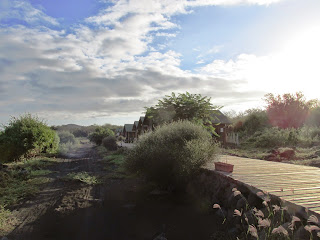
Arriving on Floreana Island, we took an open air wooden bus through lush green vegetation to the Lava Lodge, a seemingly idyllic row of wooden huts connected by a boardwalk and overlooking the waves crashing on the black lava rocks which characterize all the islands. Because of the delay, however, we arrived just as dusk was falling - no see-ums and mosquitoes were swarming, as we struggled to get indoors. Darkness fell very quickly and the one light in our cabin didn’t work, nor did the small air conditioner, due to limited electricity. At dinner I ate some delicious spinach soup but my stomach wasn’t up to any more. Our beds were very comfortable fortunately and we managed to get a little sleep in spite of the heat, humidity, and itching.


An Inauspicious Start? May 6-7
The name of this trip is “Survival of the Fittest: Hiking, Biking & Water Sports on the Galápagos Islands.” It turned out to be a bit more literal than I expected. We wanted an active trip, and we got one. There was little time for writing, reflecting, and blogging, resulting in this delayed series of posts.
Our first mistake was to take a flight with 3 legs: Salisbury-Charlotte-Miami-Guayaquil, Ecuador. The 2d flight was delayed just long enough for us to miss the Miami flight, and we spent 5 long hours in the Miami airport waiting for the next flight which left at midnight and arrived in Guayaquil about 4am. I was never more glad to see a stranger than the one holding up the sign “Road Scholar” after we disembarked and made it through customs. Fernando was our local guide for the next 2 days. After 3 hours of sleep, we immediately jumped into activities, starting with the orientation session, which revealed there were 6 people total on the trip, 2 other couples (one from San Diego and another from Montgomery County right here in Maryland, and all of them younger and fitter than us). All 3 of us women were named Cathy/Kathy, so that made it really easy to learn names. After a walking tour of Guayaquil that included a lovely botanical garden,lunch, and then kayaking and paddleboarding at a private park where we saw our first shorebirds, Ben and I were dragging and ready to go back to the hotel.


Wednesday, May 6, 2015
Galapagos!
Day 0 - Travel Day. Leaving shortly. Almost packed. Anxiety knot in stomach. What did I forget? Which of our 3 flights will be delayed? Will I survive the adventure? But, I am so lucky to be able to take this trip - it will indeed be an adventure. More later ...
Saturday, July 5, 2014
Sayonara
After breakfast Tuesday I took a last power walk around the beautiful castle park, saying goodbye to the swans, turtles, coy, and lone cormorant who reside in the castle moat. We biked over to visit the community library, and I washed one last time in the public bath in the hotel. We met my new friend Tatsui at a well-known sushi restaurant near the hotel and enjoyed the whole experience, including some (maybe a little too much) sake. By end of day we were packed and ready to go home. Early the next morning S, N, and M drove us to the small Matsuyama airport where our arduous return journey began. More than 24 hours later, after an expected 3-hr layover in the Nagoya airport, crossing back over the international date line during the 12-hr flight, and then an unexpected and unwelcome 4-hr layover in Detroit due to weather back East, I was finally back home with my guys (Ben, Wally the dog, and Wolf the cat), perhaps the most tired I have ever been. Nevertheless, in spite of my initial trepidation, I'm very glad I went. Even though we stayed mostly in off-the-beaten-path Shikoku, I believe we got a lot of the Japanese experience, and it was all good - well, OK, I'm still not a fan of eating octopus, but nevermind, I enjoyed so much else, much more than I expected, including the kindness and hospitality of the Japanese people we met. To see more selected photos from the trip, see:
https://plus.google.com/u/0/photos/107215685196650364546/albums/6032348467511677393
(You may need to copy and paste into your browser.)
Tuesday, July 1, 2014
Iya Valley: Mountains!
Seth had a day off, so all five of us took off by car for the Iya Valley mountains in the central part of Shikoku Island. After an hour or 2 of highway driving, we found ourselves on narrow winding mountain roads, switchbacking up green forested slopes, supposedly wide enough for 2 cars but sometimes having to backup to a pull-off when we met another car. Small villages were precariously perched on the steep hillsides. We stopped to cross a vine bridge, hundreds of years old (but maintained) over a deep gorge with a whitewater stream at the bottom. Pretty exciting and not easy - gaps between the slats across the bridge, which swayed with our weight as we gingerly stepped across and tried not to look down (or looked anyway) at the whitewater rushing far beneath us. We came across waterfalls, a quaint local soba noodle restaurant where we ate lunch, and a small museum devoted to local folk life. This area is known for growing, grinding, and producing the buckwheat soba noodles - our lunch was delicious and the elderly woman who ran the restaurant delighted us. Three women from Tokyo doing a driving tour engaged us in friendly conversation about where we were from and why we were there. We saw a number of tour buses - this area seems popular with Japanese tourists, but again we saw few other Caucasians during the trip. We enjoyed the famous statue of the "peeing boy" who appears to be doing just that out over the edge of the gorge (pix later. ..). Mountain views were nspectacular, especially for us flatlanders. These mountains are very green, too steep even for logging, and much newer than our Eastern US mountains, with sharper peaks. I took many pix the last 2 days, including a photo of a typical vending machine that has 2 rows of various canned coffee: black, light, au lait, many different blends and brands. The Japanese seem to love cold/iced coffee (as well as hot) and it is always good. 


Monday, June 30, 2014
Bridges and Bikes
Today may have been my favorite day so far. Now old hands at the transportation system, we took the trolley to the train station, took a train to Imabari, a lovely ride along the coast to the east, then took a taxi to where we could rent bicycles at the start of the Shimanami Sea Route, a series of 10 bridges across a group of islands that separates our island, Shikoku, from the main island. As usual, the bike rental staff were extremely friendly and helpful, both going and coming back, getting us on the right bikes and then getting us headed back to the train station. The route across the bridges and islands is about 70km, and has a separate bike lane. We biked (slowly) across the first bridge (Kurushima Kaikyo, about 6km - you didn't think we were going the whole way, did you?), which soars high above the Seto Inland Sea, affording us spectacular views of the Seto Inland Sea. The bike lane approach to the bridge spirals upward in a couple of curves to provide a gradual incline; however, it was still plenty challenging. Fortunately, we had to stop frequently to take pictures. This is the first place we saw serious bikers, wearing spandex (apparently necessary if you are going the whole way) :-) , and we were all required to wear helmets. We passed a few brave souls walking over the bridge. At the end of the bridge, on land again, we gratefully stopped for vending machine iced coffee (in cans, very common all over, and good) and snacks and rest, then turned around to go back. The weather was sunny and breezy all day, just beautiful, the first time in our whole trip. It was exhilarating. I slept very well that night.


Saturday, June 28, 2014
Oops
(Warning - this post is mainly about family stuff...) Who knew the most dangerous thing I could do in Japan is walk a baby? We took a day off to regroup. After laundry and a power walk through the green and cool of the castle park, we biked to S&N's to babysit M while mom & dad went to a DMV appt. M smiled, Grandma Susan played with him, he slept, he woke up and got fussy, Grandma walked around patting his back, which worked for a while, then he refused to drink the formula Grandma had so carefully prepared and was the perfect temperature, so finally we popped him into the belly carrier and I took him for a walk outside. Heading out, with the baby in front of me, I missed a ledge, turned my ankle, lost my balance, fell/sat down, vaguely aware of thinking in a panic "don't let the baby's head hit the pavement." I thanked God, Jesus, Buddha, Krishna, etc., that this didn't happen. I would have had to commit hara-kiri had he been hurt in any way. He got a little jerked around and cried briefly, but then we walked back and forth and then around the block. Apparently he loves to be outside and moving. He seemed to get calm and relaxed and finally slept. When I got back, his parents were home and I was very glad to see them (and so was their baby!). A few hours later, when Susan and I walked out for dinner, my ankle suddenly swelled up and I was in increasing pain. We ate fast, then Dr. Sis took charge, made me go home and put my foot up, got some ice and made an ice pack, I took 2 Advil, she went out to find a pharmacy for a cold pack and/or ankle wrap, and came back with a version of both. I had also managed to wrench my bad shoulder and had landed on my bum, and through the fog of the pain I was certain that my trip was over and that I wouldn't be able to walk or bike or go anywhere until it was time to leave. But the ice worked quite miraculously after an hour or so, then we wrapped it with this thin sticky pad and I slept well. The next morning I felt cured (almost) but Dr. Sis insists I should keep icing and resting in between outings.
Friday, June 27, 2014
Uchiko, a historic small town
A new adventure! We took the trolley for the first time, successfully, to the train station, where we also managed to buy train tickets, successfully, to go to Uchiko, a small historic town south of Matsuyama. The train ride took us gradually out of the city, through suburbs and then villages interspersed with numerous rice paddies, and then into the green hills and through some tunnels until we arrived at Uchiko at about noon. There was supposed to be a "retro" bus that took tourists around to the hot spots, but we never saw it. We had a map and after wandering around for while, noticing that nothing seemed to be open and few people around, wondered if we were in the twilight zone. Perhaps everything closes for lunch. We finally decided to take a taxi to the far end and work our way back on foot. The taxi driver was friendly and pointed out several of the sites, in Japanese, so we weren't sure what we were looking at. He dropped us at the Kosyo-ji Temple, which is also on the 88-temple pilgrimage. After regaining some peace and calm, we started down through a designated historic district, which, aong other things, contains several residences of former wealthy wax magnates open to the public. We toured one, which also had a museum with very interesting displays of wax making, from sumac tree berries. This was a thriving industry in the early part of the century, but gradually declined after the rise of paraffin wax. We had a delicious and expensive iced coffee in a cafe right in the building, an outpost of modernity and blonde wood (bamboo?), reminiscent of Scandinavia, set inside the heavy dark logs of the original building. The streets were narrow, windy, and hilly, with many homes in traditional Japanese architecture, and lined with vendors of local food and unique crafts. Our final stop was a historic Kabuki theatre (men only, with elaborate makeup), which shows Kabuki only once every 2 years, but is used for other types of entertainment such as puppetry and concerts more frequently. We had an English-speaking tour guide of the theatre, who pointed out the cheap and expensive seats, and the various entrances in the back, sides, and underneath where the actors make dramatic entrances. We would have loved to see a performance, but, needless to say, our timing was off. :-) Apparently we would need to go to Tokyo or another large city where it might be more frequently performed. As an aside, while on the ferry the other day on TV I saw a performance of an all-female troupe, doing musical numbers, with women playing both men's and women's roles. Since they were all wearing similar heavy makeup, the male parts were distinguished by clothing and haircuts. The costumes got more and more elaborate, a over-the-top mixture of Ziegfeld follies, the Rockettes, and 40's musicals. Seth said the stars of this troupe are very famous in Japan.


Thursday, June 26, 2014
Dogo Onsen Public Bath, or, How to Get Really Clean
The oldest public bath in Japan is Dogo Onsen, about 400 yrs old, a popular Japanese tourist spot. We bravely set out on the free bicycles available from our hotel, and just followed the intra-city trolley line to get there. We first visited a nearby temple, Ishite-ji, which was lovely and serene. I sat for a few minutes in the temple meditating. We observed a group of henro doing the 88-temple pilgrimage, recognizable by their white clothing, rice-paddy hats, and walking sticks. The group did some chanting while we were there. Afterwards they were very friendly, assuring me via gestures that it was OK to take pix on the temple grounds. Other visitors threw some coins into the offering box and rang a large bell, and lit incense or candles at various shrines around the temple. We saw no other Caucasians at the temple.
We then found our way to the bath, via an entrance walkway lined with souvenir shops on both sides. The drill: first remove your shoes and put them in a locker at the entrance, then pay, including renting soap, washcloth, and towel, then enter the women's bath area, put your clothes and gear in another locker, then enter the bath itself and squat on a low stool in front of a sink along the side and scrub yourself thoroughly with soap and rinse well, and only then step into the very hot water of the hot spring bath, where you can only stand it for a few minutes. A highlight was an cheerful old woman who offered to scrub our backs while we were washing and included some skillful back and shoulder massage that felt great. This whole experience is very traditional Japanese and I have no regrets about doing it, but, honestly, all for a few minutes in a hot tub? Then by the time we biked back to the hotel I was all hot and sweaty again and ready for another bath!
Tuesday, June 24, 2014
Hiroshima
The next day we traveled to Hiroshima to visit the Peace Park. It began with a relaxing 3-hr ferry ride among numerous mostly uninhabited small islands in the Seto Inland Sea that separates Shikoku Island from the main island and Hiroshima. The Peace Museum describes the history and politics leading to dropping the "A-bomb" and was relentless in describing the subsequent devastation, and then the gradual rebuilding of the city and its commitment to become a model for world peace and the extinction of nuclear weapons. Our spirits were lifted by the various memorials such as the 1000 cranes, the Peace Bell, the Atomic Memorial Mound (which contains the ashes of about 70,000 victims), the A-Bomb Dome, which partially survived the blast and stands in memory, and the Flame of Peace, which will only be extinguished when all nuclear weapons have been destroyed.


A Traditional, and Artful, Japanese Meal
The highlight of Sunday was lunch at a fancy Japanese restaurant hosted by Nagi's parents, and attended by her sister and spouse, brother & spouse & 3 kids, as well as all of us. It was an exquisite Japanese meal. We sat around a traditional low table, but thankfully with space to dangle our legs underneath. The lunch consisted of a seemingly never-ending sequence of small plates and bowls served to us, including soup, sashimi, tempura, and numerous other very artfully arranged small plates with a variety of vegetables and seafood combinations. I loved (almost) everything! There was some gift giving and appreciating. Nagi's parents do not speak English, so much translation and gesturing took place. I was sitting across from Nagi's father, who grows oranges, and he politely and helpfully gestured to help me figure out the appropriate way to eat everything. They were lovely people, we enjoyed it very much, and were grateful for the opportunity for this experience.


Sunday, June 22, 2014
A Castle and a Festival
Very full day! We can't believe we've only been here 3 days. We walked to the Matsuyama Castle, the main tourist site in the city, as much a fort as a castle, originally built in 1600s, added to or reconstructed each century since, sitting on top of a hill, now in the middle of a beautiful park with numerous walking trails, and around which the original city was built. It was about 98% humidity as we slowly trudged up the hill along with numerous Japanese tourists. It was a pleasant surprise to find English translations on many of the displays. At the top one can see views of the city out the windows of the main building, and tour a small museum about the various lords of the castle. Back at the bottom we visited the Shinonome shrine, so beautiful, quiet, and peaceful. Hot and tired, we looked for lunch places and stopped at one of the very few we have seen that had English signage outside: "fish and chips". The woman at the counter enthusiastically greeted us, and seemed incredibly grateful for our patronage, as there was no one else there. My fish sandwich and Sue's fried chicken were pretty awful, but we had great iced coffee and enjoyed people-watching and were apparently much appreciated.
After a brief recovery enjoying the hotel's A/C, we set out for a Saturday festival which takes place along 2 long streets in an L shape which are permanently closed to traffic, covered, and lined with many shops and eating establishments on either side, with special food kiosks and entertainment for the festival in the middle, offering a variety of local delicacies and wares. Perhaps the most interesting, and, frankly, creepy, was a kiosk filled with small cages and open boxes containing live, 3-5 inch long black beetles. One assumes people buy them for pets. The Japanese certainly have a complicated relationship with nature (think shark fin soup, dolphins and whales, and what I recently read in the guidebook about captive "trained" cormorants that catch fish but can't swallow them so that the fishermen who have ringed their necks make them cough up the fish into the boat). Later we had a delicious dinner at home at the compact apartment of the "kids", during which Great-Aunt Cathy got to dance with 3-month-old Minato. What a sweetheart!


Subscribe to:
Posts (Atom)